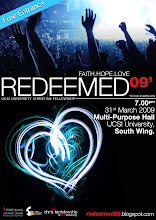
Redeemed 09' Official Promo Video

Showing posts with label Life. Show all posts

Wednesday, March 25, 2009

Life-RW 2008

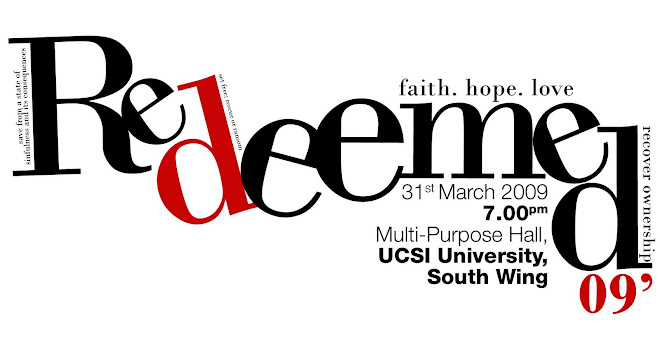
It's about a week till Redeemed 09'. So we'd thought we'd share with you guys some pictures of what went down last year. Time really flies and it's already been a year since Life-RW. Redeemed 09' will come and go as fast as Life-RW did.

Our mission remains the same as ever before; to share God's love with the people that matter most to us in our lives. Redeemed 09' is the perfect opportunity to do so though may I add NOT the ONLY opportunity to do so.

However the question remains, has your life been re-written or your life been redeemed? We pray that this coming Easter would shed a whole new dimension into your life and into the lives of the people you know by experiencing God’s love for each and everyone of us.

Has your life been redeemed?


Monday, March 16, 2009

Making Friends...

A letter from a friend described the adjustments that his son and daughter-in-law were facing as young missionaries in a country long resistant to the gospel of Christ. "After some rough early going," he wrote, "they are getting used to not having modern conveniences and are falling in love with the people."

A photo showed the couple's 2-year-old-son Wesley and a waiter in a restaurant, both grinning widely as they shared a moment of friendship. My friend commented, "Ever smiling, Wesley makes friends wherever he goes." That got me to thinking. Making friends and loving people is the key to sharing the gospel wherever we are, because that's what Jesus did.

Some religious leaders were surprised when Jesus openly associated with people they considered undesirable. They said to His disciples, "How is it that He eats and drinks with tax collectors and sinners?" (Mark 2:16). Yet Jesus was known as the friend of sinners. He said, "I did not come to call the righteous, but sinners, to repentance" (v.17).

A loving heart and a friendly smile go a long way to communicate the love of Christ to the people we meet each day. May they say of us, as they did of little Wesley, "Ever smiling, he makes friends wherever he goes." — David C. McCasland


To the lost is where Christ went,Revealing grace from God above;To lost sinners we've been sentTo be their friends, to share God's love. —Fitzhugh

Loving the lost is the first step in leading them to Christ.

Saturday, March 14, 2009

Tick Tick Tick...


Do you have a clock or watch available with a secondhand on it? Stop and follow that hand as it ticks away 1 minute. Those seconds, of course, are the way we measure time, and time is the very essence of our lives. By the time you reach the age of 75, the clocks and watches of this world will have ticked away a total of nearly 2.5 billion seconds.

Bernard Berenson, an internationally famous art critic, had a zest for life. Even when he was in ill health, he cherished every moment. Shortly before he died at age 94, he said to a friend, "I would willingly stand at street corners, hat in hand, asking passersby to drop their unused minutes into it." Oh, that we would learn to appreciate the value of time!

We certainly don't want to be so time-conscious that we become driven workaholics, neglecting our families, never relaxing with our friends, too busy to smell the roses or admire a sunset. Yet Paul urged us to redeem the time (Ephesians 5:15-16), and Moses prayed, "Teach us to number our days, that we may gain a heart of wisdom" (Psalm 90:12).

Let's ask the Lord to help us appreciate the value of time. May we wisely invest our seconds, minutes, hours, and days, realizing that beyond time lies eternity. — Vernon C. Grounds


We do not know how long we have Till time for us is past,So let us live as if this dayIs going to be our last. —DJD

To spend time wisely, invest it in eternity.

Wednesday, March 4, 2009

Dear God...

This item appeared in a newspaper after the 1999 fatal shooting at Columbine High School in Colorado:

Dear God: Why didn't You save the children of the Littleton school? —Sincerely, a student

Dear Student: I am not allowed in schools. —Sincerely, God

The intended message seems clear: If we bring God back into the public schools by allowing prayer and Bible reading, then such tragedies would not occur. Whether you agree with that sentiment or not, one thing is sure—laws can't keep God out of school. They didn't that fateful day at Columbine High! God reached out to the gunmen through those who confessed their faith in Christ before being shot. He was there in the courage of a teacher who gave his life helping students escape.

God may be doing His greatest work when evil seems to triumph. When Job looked back, he saw that his suffering gave him a new understanding of God (Job 42:5-6). At Calvary, man crucified the only sinless One who ever lived, yet God turned history's darkest day into man's redemption.

Are you facing a great injustice? Keep trusting God. Those who go through the greatest darkness are those who most fully appreciate the glory of His light. — Dennis J. De Haan

When tragedy, heartache, and sorrow abound,When evil appears to have conquered the right,We center our heart on our Father's great love,For He will bring hope in the darkest of night. —DJD


God may be doing His greatest work when evil seems to triumph.

Monday, March 2, 2009

The L word...


In the movie Fever Pitch, Ben Wrightman is crazy about the Boston Red Sox baseball team. He rarely misses a game during the spring and summer months.

One winter, Ben falls in love with a young woman named Lindsey and wins her heart. Then spring rolls around, and she finds out that he’s a different person during baseball season. He has no time for her unless she goes to the games with him.

When Lindsey ends her relationship with Ben because of his fanaticism, he talks with a young friend, who says, “You love the Sox. But tell me, have they ever loved you back?” Those words cause Ben to analyze his priorities and to give more time to the woman he loves, who loves him back.

We pour our lives into hobbies, pleasures, activities, work—many good things. But two things should always be thought about when making our choices. Jesus said, “You shall love the Lord your God with all your heart . . . . You shall love your neighbor as yourself” (Matt. 22:37,39).

When it seems our life is getting out of balance, the question, “Has that hobby or activity or thing ever loved me back?” may help to keep us in check. Loving God and loving people are what really count. — Anne Cetas


Follow with reverent steps the great exampleOf Him whose holy work was doing good:So shall the wide earth seem our Father’s temple,Each loving life a psalm of gratitude. —Whittier

We show our love for God when we share His love with others.

Sunday, February 22, 2009

God's Existance...

If God exists, why doesn’t He make His existence something provable and undeniable?

God may have designed the universe so that the motive for faith must be as much moral, relational and spiritual as it is logical. Consider what the author of the Epistle to the Hebrews writes:
Now faith is being sure of what we hope for and certain of what we do not see. This is what the ancients were commended for. By faith we understand that the universe was formed at God’s command, so that what is seen was not made out of what was visible. By faith Abel offered God a better sacrifice than Cain did. By faith he was commended as a righteous man, when God spoke well of his offerings. And by faith he still speaks, even though he is dead. By faith Enoch was taken from this life, so that he did not experience death; he could not be found, because God had taken him away. For before he was taken, he was commended as one who pleased God. And without faith it is impossible to please God, because anyone who comes to him must believe that he exists and that he rewards those who earnestly seek him. (Hebrews 11:1-6 NIV, italics added).

In fact, the intrinsic nature of faith, hope, and love are such that they shouldn’t and can’t be reduced to mere logic. If God designed the universe so that His presence could be “proven” in the scientific, mathematical sense, faith wouldn’t have to be a decision of the heart. It would be mere acquiescence of the mind, motivated by necessity and fear but not by love. If faith, hope, and love were reduced to a logical decision, freedom would vanish. Who would dare stand against God if logic always seemed completely on the side of faith? If God’s existence and ultimate control were undeniable, people would obey out of fear and would struggle to conceal their resentment.

Rather than being a loving, heavenly Father who allows prodigals to make mistakes, repent, and come home to experience His love, He would be viewed as such an ominous authority that creatures would never dare become prodigals, who by returning to faith could discover freedom, individuality, calling, and love. Self-awareness would be overwhelmed by the obviousness of God’s presence. Creatures would be so engulfed by His power and glory that they couldn’t even begin to discover themselves. Love as we know it could never exist in such a world.

This may be why faith, hope, and love affirm logic but transcend it; why they must involve moral choice rather than mere logical deduction. This too may be why He employs randomness within the creative process, leaving profound evidence of His involvement and presence but doing nothing to coerce obedience.

1. “I believe that we Christians are warranted in seeing every potentially viable life form (or every viable variant of DNA) as something thoughtfully conceived in the mind of the Creator. As did Basil and Augustine, I believe that we may rightfully speak of God calling into being at the beginning, from nothing, all material substance and all creaturely forms (whether inanimate structures or animate life forms). And, still standing with Basil and Augustine, I believe that we may rightfully presume that the array of structures and life forms now present was not yet present at the beginning, but became actualized in the course of time as the created substances, employing the capacities thoughtfully given to them by God at the beginning, functioned in a gapless creational economy to bring about what the Creator called for and intended from the outset.

“In the context of this traditional Christian vision of God’s creative work . . . , we might now wish to employ the vocabulary of twentieth-century science and speak about the full array of functionally viable forms of DNA (and the creatures thereby represented) as constituting a ‘possibility space’ of potential life forms—this possibility space itself, along with all connective pathways, being an integral component of the world brought into being at the beginning. Furthermore, in the language of this theistic paradigm of evolutionary creation, we would speak of DNA being enabled by the Creator to employ random genetic variation as a means to explore and discover (in contrast to create) viable pathways and novel life forms so that the Creator’s intentions for the formative history of the Creation might be actualized in the course of time.

“See, then, what this evolutionary creation paradigm accomplishes: Do material processes have to create? No, the possibility space of viable and historically achievable life forms is an integral aspect of the world that God created at the beginning. Material systems need only employ their God-given functional capacities to discover some of the possibilities thoughtfully prepared for them. But, one might ask, how can such ‘mindless’ material processes function to bring about what appears to be the product of ‘intelligent design’? The point is that they are not really mindless at all. Rather, every one of these processes and every connective pathway in the possibility space of viable creatures is itself a mindfully designed provision from a Creator possessing unfathomable intelligence.

“It seems to me that this theistic paradigm provides precisely what the naturalistic (broad) paradigm—the blind watchmaker hypothesis—could not. It provides the answer to the question, How is it possible that such a remarkable array of life forms is not only viable but historically realizable within the economy of the world at hand? Could anything less than the infinite creativity and faithful providence of God suffice?” (Howard Van Til, First Things, July/August 1993)
Saturday, February 14, 2009

Pardon Me...


Hijackers terrorized the passengers aboard an Indian Airlines jet for 8 days. Then, on December 31, 1999, the gunmen issued a final demand before releasing their hostages. "Sorry, but everyone has to say that I am forgiven," said the hijacker code-named "Burger." When the disbelieving passengers stared back at him, he ordered them to say, "I forgive you." After hearing the words, the hijackers disappeared into the desert.

Not many of us would be so arrogant as to insist that someone forgive us. And we certainly wouldn't demand that of God. Why? Because most people sense that His mercy and pardon can be received only by a humble, sincere, and repentant heart.

The apostle John wrote, "If we confess our sins, He is faithful and just to forgive us our sins and to cleanse us from all unrighteousness" (1 John 1:9). The word translated "confess" means "to speak the same thing or agree with." When we confess our sins to God, we agree with Him about our sin, our need to be cleansed, and our need to forgive others who have wronged us (Matthew 6:15).

We cry out, "Pardon me!"

None of us is truly free without forgiveness. We need God's, and others need ours.

— David C. McCasland
Forgive me, O Lord, for all of my sin,Please make my heart pure and cleanse me within;Confessing to You what I have done wrong,Restore now my joy—to You I belong.
Confession is the key that opens the door to forgiveness.